A Tailor-Made Feast
Historical Thinking Activities and Games That Help You Think Like a Historian
Historical Thinking Activities and Games That Help You Think Like a Historian
Couldn't load pickup availability
Discover History Through Play with Think Like a Historian!
Make history your child’s most thought-provoking subject. This collection of historical thinking games and activities for late elementary students and older transforms history lessons into active investigation. Designed for family-style homeschool lessons or co-op classrooms, these games help students analyze evidence, wrestle with cause and effect, compare perspectives, and understand how memory shapes the past.
Why Choose Think Like a Historian?
This flexible, open-and-go guide equips you to teach the habits of mind real historians use. Instead of memorizing isolated facts, students practice questioning sources, placing events in context, weighing multiple viewpoints, and building logical historical arguments.
Each activity can be adapted to whatever time period or topic you are studying—Ancient Rome, the American Revolution, West African kingdoms, or modern history—making this a reusable tool for years of learning.
What’s Inside the Guide?
Eight Engaging Historical Thinking Games:
Hexagonal Thinking
Students connect events, people, and ideas to reveal relationships and patterns across time.
Source Detective
Learners investigate primary sources, asking who created them, why, and whether they can be trusted.
Then, Elsewhere, and Now
Students compare events across time and place, strengthening contextual thinking and global awareness.
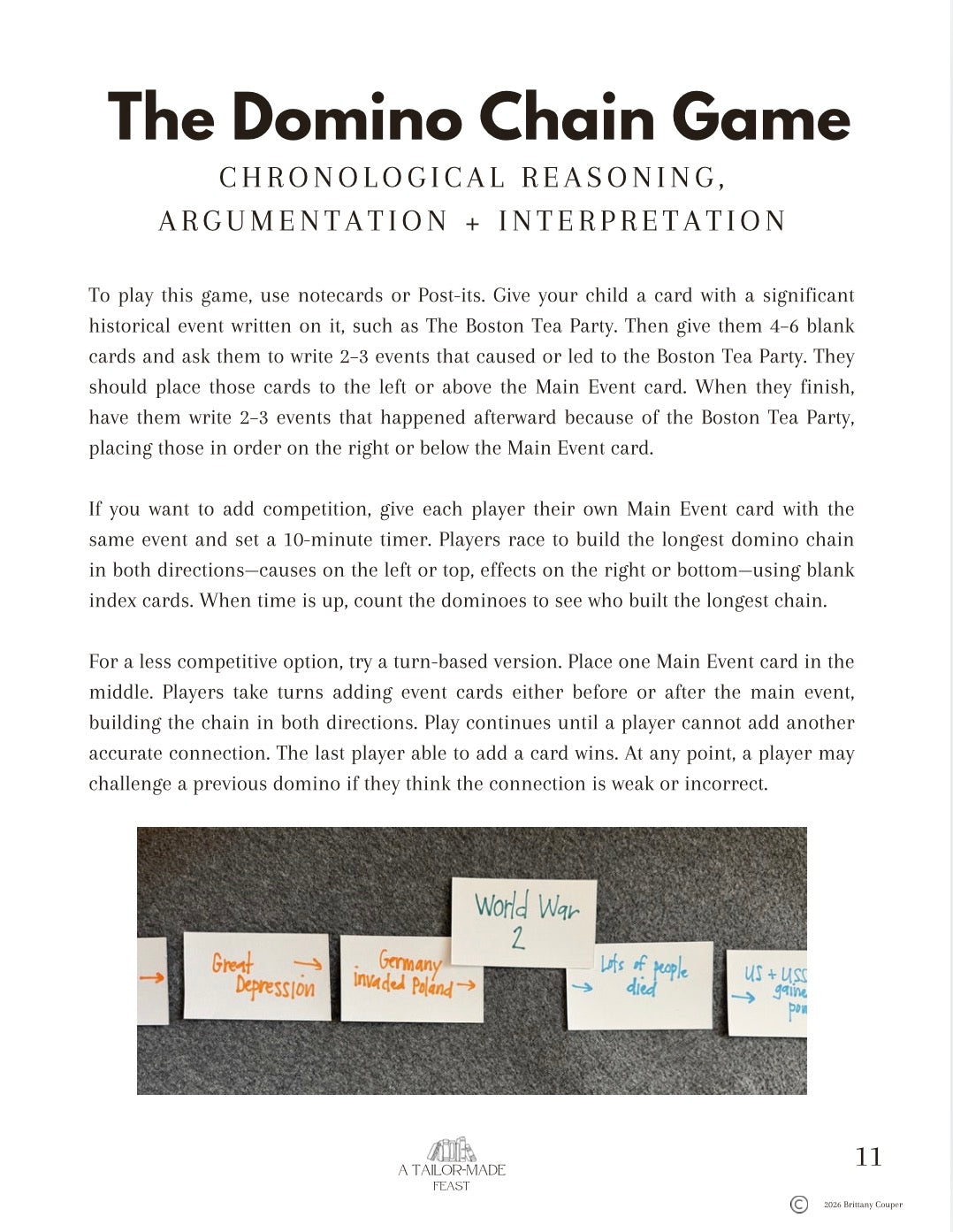
The Domino Chain Game
A dynamic cause-and-effect activity that helps students trace how one decision or event leads to another.
What If?
A structured counterfactual exercise that sharpens understanding of historical contingency—what changed history, and what might not have.
Headline Historians
Students distill complex events into concise headlines, practicing interpretation and bias awareness.
Chronology Challenge
A hands-on sequencing game that builds deep timeline understanding beyond memorized dates.
Memory as History
An exploration of how personal memory and cultural memory shape the stories societies tell about the past.
Skills Developed:
Sourcing: Learning to question who created a document and why.
Contextualization: Placing events within their larger political, cultural, and global setting.
Corroboration: Comparing accounts to identify agreement, disagreement, and bias.
Cause and Effect Reasoning: Tracing short-term and long-term consequences.
Historical Argumentation: Supporting claims with evidence rather than opinion.
Flexible and Easy to Use
Each game includes:
Clear instructions for home or co-op use
Adaptations for mixed ages
Minimal prep options and printable templates
Guidance for scaling up discussion depth for older students
No advanced history degree required. The guide walks you step-by-step through leading meaningful discussions while keeping the atmosphere lively and engaging.
What Makes This Guide Special?
Reusable Across All Time Periods
Once you learn the games, you can apply them to any era or region you study.
Family-Style Friendly
Designed for multi-age homeschool settings and adaptable for co-op classrooms.
Engaging Without Being Silly
Students feel like investigators, not test-takers.
Builds Real Intellectual Muscles
Children learn to think carefully, weigh evidence, and form reasoned conclusions—skills that extend far beyond history.
Perfect For...
Homeschool families teaching late elementary through high school.
Co-op leaders who want interactive, discussion-rich history lessons.
Parents who want more than memorization and narration.
Families seeking meaningful, skill-building history instruction that works with Charlotte Mason or eclectic approaches.
Ready to Bring History to Life?
With Think Like a Historian: Historical Thinking Games and Activities, you’ll give your students tools that historians actually use—tools that build discernment, curiosity, and intellectual courage.
History becomes less about remembering what happened and more about understanding why it mattered—and how we know.
Share